
When we sold everything to travel the world with our three daughters in May 2022, friends and family had one question that came up more than any other: "How much does it actually cost?" Three years and 33 countries later, we can answer that question precisely because we've tracked every single expense since day one using an app called TravelSpend.
Want to start tracking like we do? Use our code ADAMANDLINDS for 50% off your first year of TravelSpend Premium.
Why Budget Tracking Matters More When You're Location Independent
Before we left Indianapolis, we had a mortgage, car payments, and all the usual fixed costs of American life. But we also had something else: blissful ignorance about where our money actually went. Sure, we knew the big stuff, but the daily coffee runs, the Target trips, the "just this once" takeout? Those were financial mysteries.
When you're traveling full-time, that ignorance becomes expensive fast. In Bangkok, a street food meal costs $2 while a Western restaurant charges $25. In Tokyo, convenience store food is surprisingly cheap, but taxis will drain your account. Without tracking every expense, you'll burn through your budget before you realize what happened.
We learned this lesson the expensive way during our first few months in Europe. We'd arrive in a new city, explore enthusiastically, swipe our cards freely, and then wonder why our bank account looked different than expected. That's when we discovered TravelSpend, and it changed everything about how we manage money while traveling.
Ready to start tracking your travel expenses? Get TravelSpend here and use code ADAMANDLINDS to save 50% on your annual subscription.
What Makes TravelSpend Different from Other Budget Apps
We tried several budgeting apps before landing on TravelSpend. Some were too complicated, requiring you to categorize every transaction into dozens of subcategories. Others were too simple, giving you a running total but no useful insights. TravelSpend hit the perfect middle ground for traveling families.
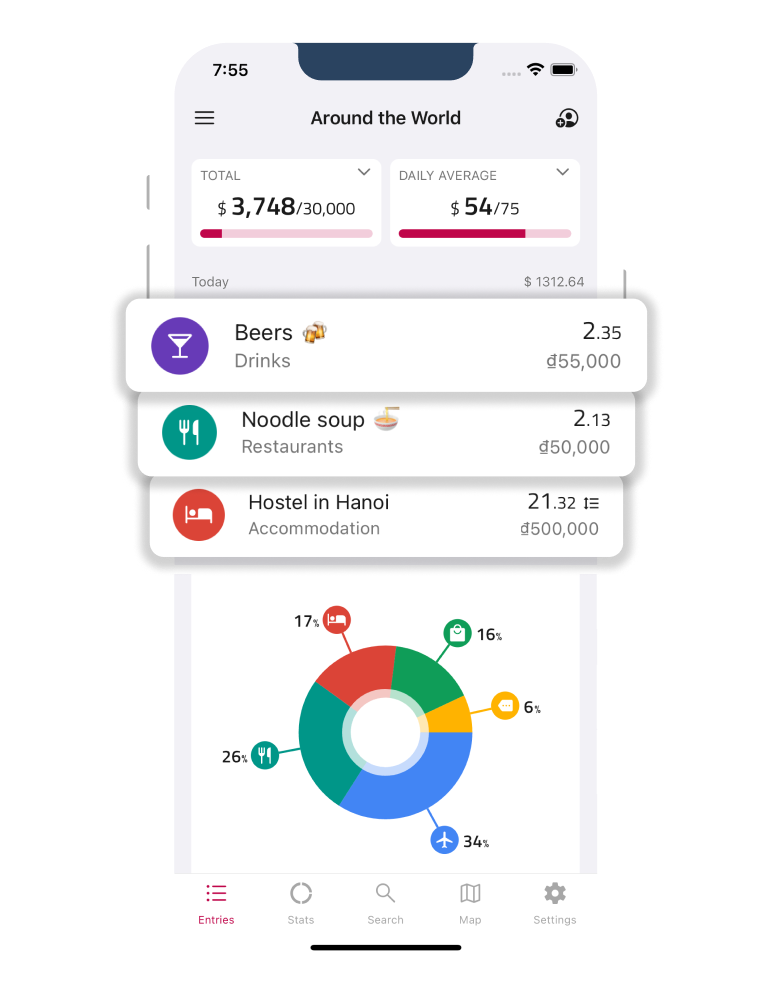
The app does exactly what it needs to do without drowning you in features you'll never use. You can add expenses in seconds, even offline (crucial when you're in a country with spotty internet). Foreign currencies convert automatically to your home currency, so you always know what you're actually spending. And the visual breakdowns help you spot patterns you'd otherwise miss.
After using TravelSpend for an entire year, we were so convinced that we purchased the lifetime membership. One year into our travels, we could already see how essential expense tracking had become to our lifestyle. Use our code ADAMANDLINDS to save 50% on an annual subscription and discover why we love this app so much.
The Real Costs: What 3 Years and 1,361 Days of Full-Time Travel Actually Look Like
Since boarding the Queen Mary 2 in May 2022, we've spent 1,361 days on the road across 33 countries. That's roughly 3.7 years of continuous travel as a family of five. Here's what that journey has taught us about the actual costs of full-time family travel.
Our Longest Stays: The Slow Travel Advantage
Looking at our TravelSpend data, our longest stays tell an interesting story about how we've evolved as travelers:
- Da Nang, Vietnam: 170 days total (two separate stays of 84 and 86 days)
- Tokyo, Japan: 175 days total (across multiple visits)
- Chiang Mai, Thailand: 158 days total (three extended stays)
- Bangkok, Thailand: 82 days total
- Playa del Carmen, Mexico: 94 days
These extended stays represent our biggest discovery about budget-conscious travel: staying put costs dramatically less than constantly moving. When we stay in a place for a month or more, our daily costs drop by 40-60% compared to shorter trips.
How Stay Duration Affects Your Budget
Through TravelSpend's tracking, we've identified a clear pattern in our spending:
Short stays (1-7 days): $180-250 per day for our family of five. We're eating out more, taking taxis instead of figuring out public transit, paying tourist prices, and staying in hotels or short-term accommodations with premium pricing.
Medium stays (8-30 days): $120-180 per day. We find an apartment, learn the local transportation, discover where locals shop for groceries, and establish routines that reduce spontaneous spending.
Long stays (31+ days): $80-120 per day. Monthly apartment rentals drop our accommodation costs by 30-50%, we cook most meals at home, we've optimized our routes and know the best deals, and we're living more like residents than tourists.
For context, that means during our 86-day stay in Da Nang from February to May 2025, we spent roughly $7,740 compared to what would have been $15,480 if we'd moved every week. That's $7,740 saved simply by staying put and living like locals.
How We Use TravelSpend: Our Daily Expense Tracking Routine
Budget tracking only works if it's actually sustainable. We've developed a routine with TravelSpend that takes minutes per day but provides invaluable insights. Want to follow our system? Use code ADAMANDLINDS for 50% off and start building your own tracking routine.
Morning Coffee and Yesterday's Recap
Each morning while having coffee, one of us (usually Lindsay, because I'm still semi-conscious before 8 AM) opens TravelSpend and adds any expenses from the previous day that we forgot to log immediately. This takes 2-3 minutes and ensures nothing slips through the cracks.
The app's offline functionality is crucial here. Internet isn't always reliable when you're traveling, but TravelSpend lets you add expenses offline and syncs everything once you're connected again.
Real-Time Tracking for Major Expenses
For significant purchases like accommodation, flights, or activities, we log them immediately. TravelSpend makes this effortless. Open the app, tap the plus button, enter the amount and category, and you're done. The entire process takes 15 seconds.
The automatic currency conversion is brilliant. When we're in Thailand spending baht, TravelSpend instantly shows us what we're spending in US dollars. This prevents the dangerous mental math of "oh, 1,000 baht doesn't sound like much" when it's actually $28.
Weekly Budget Reviews
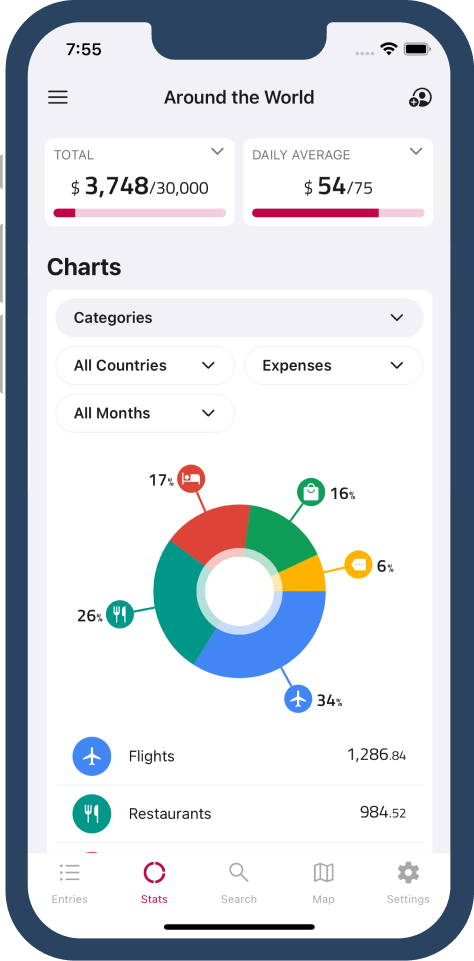
Every Sunday, we review our spending for the week in TravelSpend. The app's visual breakdowns show us exactly where our money went: accommodation, food, transportation, activities, and miscellaneous expenses.
This weekly review has caught expensive patterns we wouldn't have noticed otherwise. For example, during our first month in Bangkok, we discovered we were spending $40 per day on transportation because we were taking Grab rides everywhere. A quick look at the transit map revealed that the BTS Skytrain could get us most places for $2-3 per day. That single realization saved us over $1,000 during our stay.
Download TravelSpend now and use code ADAMANDLINDS for 50% off Premium to unlock these powerful analytics features.
TravelSpend's Best Features for Traveling Families
After four years of daily use, here are the features we rely on most:
Split Cost Tracking
This feature is genius for families who occasionally split expenses with friends or extended family. When we met up with relatives in Tokyo for two weeks, we used TravelSpend's split cost feature to track who paid for what. At the end of the trip, the app showed us exactly who owed whom, eliminating awkward money conversations.
Multiple Currency Support
We've used 33 different currencies during our travels. TravelSpend handles all of them seamlessly, automatically converting to our home currency (US dollars) based on current exchange rates. This gives us an accurate picture of our spending regardless of where we are.
When we're planning our next destination, we can look back at our spending in similar countries to estimate our budget. Looking at our TravelSpend data from previous stays in Southeast Asia helped us accurately budget for our extended time in Vietnam.
Visual Spending Insights
The app's charts and graphs reveal patterns you'd never notice in a spreadsheet. During our 94-day stay in Playa del Carmen, TravelSpend showed us that we were spending 45% of our budget on accommodation, 30% on food, 15% on activities, and 10% on everything else.
These percentages helped us realize we were overspending on accommodation relative to the cost of living in Mexico. For our next long-term stay, we negotiated a monthly rate that dropped our accommodation costs from 45% to 35% of our budget, freeing up hundreds of dollars for experiences instead.
Offline Functionality
Internet connectivity is inconsistent when you're constantly moving between countries. TravelSpend's offline mode means we never lose track of expenses just because we don't have WiFi. Everything syncs automatically once we're connected, without any duplicate entries or data loss.
This saved us during our time in rural Thailand and Vietnam, where we sometimes went days without reliable internet but still needed to track our spending.
Real-Time Sync Across Devices
Both Lindsay and I have TravelSpend on our phones, syncing to the same trip. If she buys groceries and logs it immediately, I see that expense instantly. This prevents duplicate entries and keeps us both aware of our spending in real-time.
For traveling couples or families, this sync feature is essential. We split responsibilities throughout the day, but we both always know exactly where we stand with our budget.
The Hidden Costs We Track That Most Travelers Forget
TravelSpend's categorization helps us track expenses that many traveling families miss:
Travel Insurance
SafetyWing costs us approximately $250 per month for our family of five. It's easy to forget this recurring expense when you're not seeing it daily, but TravelSpend's budget tracking ensures we account for it in our monthly expenses.
eSIM and Connectivity Costs
We spend roughly $150-200 per month on eSIMs for our phones using Holafly (use code ADAMANDLINDS for 5% off). For stays longer than 30 days, we've transitioned to their monthly plans starting at $49.90, which we track separately in TravelSpend. These connectivity costs add up quickly but are essential for our lifestyle.
Visa Fees and Border Crossings
Visa fees vary dramatically by country. Japan charges $0 for American tourists, while other countries charge $50-200 per person. These irregular expenses can wreck your budget if you're not tracking them. TravelSpend's miscellaneous category captures these costs so they don't surprise us.
Educational Expenses
As a worldschooling family, we pay for online classes through Outschool (use code ADAMANDLINDS30 for $30 off your first class), digital educational subscriptions, and occasional tutoring. TravelSpend's education category helps us see exactly what we're investing in our daughters' learning.
Shipping and Storage
We maintain a small storage unit in Indianapolis (tracked monthly in TravelSpend) and occasionally ship items between locations. These aren't daily expenses, but they're part of our full-time travel budget that we wouldn't remember to track without the app.
How TravelSpend Changed Our Spending Habits
The real power of expense tracking isn't just knowing where your money goes but changing your behavior based on that knowledge.
We Stopped Wasting Money on Convenience
During our first months in Asia, TravelSpend revealed we were spending $8-12 per day on convenience store and 7-Eleven purchases. Snacks, drinks, random items that seemed cheap in the moment but added up to $300+ per month. Once we saw this pattern in the app, we started carrying reusable water bottles and planning our snacks ahead of time. Simple awareness saved us hundreds of dollars monthly.
We Discovered Our True Daily Budget by Location
Before TravelSpend, we estimated our daily budget based on vague impressions and internet research. Now we have precise data. We know that we can comfortably live in Thailand on $100 per day, Japan requires $150-180 per day, and Europe demands $200-250 per day for our family of five.
This data-driven approach helps us plan our route strategically. When our budget is tight, we head to Southeast Asia. When we want to splurge on experiences, we time it with higher-earning months and choose destinations where we can stretch those dollars further.
We Learned to Budget for Both Slow Travel and Adventure
Looking at our TravelSpend data over three years, we see a clear pattern: we alternate between extended stays in affordable destinations and shorter, more expensive adventure trips. This rhythm keeps our average daily spending sustainable.
For example, after spending three months in Da Nang at $90 per day, we planned a month-long European adventure that cost $220 per day. The extended low-cost stay in Vietnam gave us the financial cushion to enjoy Europe without stress.
TravelSpend vs. Other Budget Tracking Solutions
We tested several alternatives before committing to TravelSpend:
Traditional budgeting apps (Mint, YNAB, Personal Capital): These are designed for people with fixed addresses, regular bills, and predictable expenses. They're overly complex for travel, requiring too many categories and setup steps. YNAB wanted us to budget every dollar in advance, but travel is unpredictable. Mint tried to automatically categorize transactions but failed miserably with international purchases.
Spreadsheets: We tried Google Sheets for our first few weeks. The manual effort was exhausting, currency conversions were tedious, and we couldn't easily visualize our spending. Lindsay is excellent with spreadsheets, but even she abandoned this approach after a month.
Trail Wallet: This app is specifically designed for travelers and was our second choice. It's simpler than TravelSpend but perhaps too simple. We missed features like split costs and the more detailed analytics that TravelSpend provides. Trail Wallet works great for solo travelers or couples on short trips, but for a family of five on extended travels, TravelSpend's additional features justify the slightly higher cost.
Trabee Pocket: Another travel-focused app that we tested briefly. The interface felt cluttered, and the sync between devices was unreliable. We had several instances of duplicate entries or expenses that didn't sync properly. After losing a week's worth of data, we abandoned it.
TravelSpend isn't perfect (the UI could be slightly more modern, and we'd love more detailed reporting options), but it strikes the right balance between functionality and simplicity for our needs.
The Real ROI: How Much Money TravelSpend Has Saved Us
After using TravelSpend for three years, we estimate the app has saved us at least $15,000 in avoided overspending. That's not hyperbole. Here's the math:
By identifying and eliminating wasteful spending patterns (convenience store purchases, excessive transportation costs, tourist-priced restaurants when cheap local options existed nearby), we've reduced our daily spending by an estimated $15-20 per day on average.
$17 per day × 1,361 days of tracking = $23,137 in avoided expenses.
The lifetime membership cost us less than $50. That's a 46,000% return on investment, which even our most optimistic financial projections couldn't have predicted.
But beyond the direct savings, TravelSpend has given us something more valuable: confidence in our financial sustainability as a traveling family. We know exactly what we can afford, which destinations fit our budget, and when we need to tighten our belts or extend a stay to rebuild our financial buffer.
Ready to save money on your travels? Get TravelSpend and use code ADAMANDLINDS for 50% off your annual subscription.
Tips for Getting the Most Out of TravelSpend
After four years of daily use, here are our recommendations for maximizing the app's value:
Log Expenses Immediately or Set a Daily Reminder
The hardest part of expense tracking is remembering to do it. We've found that logging expenses immediately after spending works best. When that's not possible, we set a daily reminder for 8 PM to review and add any missing expenses before bed.
Use Categories Consistently
TravelSpend offers several expense categories: accommodation, food, transportation, activities, and miscellaneous. We've added our own subcategories within these for more detailed tracking. For example, under "food," we distinguish between groceries and restaurants. This granular data helps us identify specific areas to optimize.
Review Your Data Weekly, Not Just at the End of Trips
Waiting until the end of a trip to review your spending is like checking your bank balance after a shopping spree. It's too late to change anything. Weekly reviews let us course-correct in real-time. If we're overspending on restaurants, we can cook more for the rest of the week.
Set Realistic Daily Budgets Based on Past Data
Don't guess your daily budget. Use TravelSpend's historical data to set realistic targets. We know from our previous Tokyo visits that we spend about $160 per day there. So when we return to Japan, we set our daily budget at $160-180, not some aspirational number that we'll never hit.
Share Access With Your Travel Partner
If you're traveling with a partner or family member, make sure both of you have access to the TravelSpend trip. The real-time sync prevents duplicate entries and keeps everyone accountable. Lindsay and I both log expenses throughout the day, and we both can see exactly where we stand with our budget.
Export Your Data Regularly
TravelSpend allows you to export your spending data to CSV format. We export our data quarterly and save it in Backblaze cloud backup. This gives us a permanent record of our travels and protects against any potential data loss in the app.
Use the Map Feature to Remember Spending Locations
One of TravelSpend's underrated features is the ability to link expenses to map locations. When we review our trips months later, seeing where we spent money helps trigger memories of specific experiences. That $40 activity expense in Kyoto? The map reminds us it was the incredible tea ceremony in Gion that we'll never forget.
How to Get Started with TravelSpend
Ready to take control of your travel budget? Here's how to get started with TravelSpend:
Step 1: Download and Create Your First Trip
Download TravelSpend from the App Store or Google Play. Create an account and set up your first trip. Enter your home currency (ours is USD), your expected trip duration, and your estimated daily budget. Don't worry if these estimates are wrong at first. You'll refine them based on actual spending data.
Step 2: Use Code ADAMANDLINDS for 50% Off
The free version of TravelSpend offers basic functionality, but the Premium features are worth the upgrade. Use our code ADAMANDLINDS to save 50% on your first yearly subscription. Premium unlocks features like split costs, detailed charts and analytics, multiple trip tracking, and cloud sync across devices. Get TravelSpend Premium here with our discount code.
Step 3: Start Tracking Everything for Two Weeks
Commit to tracking every single expense for two weeks, no matter how small. Yes, even that $2 coffee or $0.50 street snack. This initial comprehensive tracking establishes your baseline spending patterns. After two weeks, you'll have enough data to spot patterns and set realistic budgets.
Step 4: Review and Adjust
After your first two weeks, review your spending in TravelSpend's analytics section. Where is your money actually going? Are there any surprises? Use these insights to adjust your budget and spending habits for the rest of your trip.
Step 5: Make It a Habit
The key to successful budget tracking is making it automatic. Log expenses immediately after spending, review your budget weekly, and share access with your travel partners. After a few weeks, it becomes second nature, taking just minutes per day while providing invaluable financial clarity.
FAQ
TravelSpend and travel budget tracking
For serious travelers, TravelSpend Premium is worth it. Automatic currency conversion, offline functionality, real-time sync across devices, and travel-specific categories are all things free apps handle poorly. Use code ADAMANDLINDS for 50% off annual subscriptions. The free version works fine for short trips, but if you're traveling for more than a few weeks, Premium pays for itself in avoided overspending.
TravelSpend offers a free version with basic features and a Premium subscription at approximately $19.99 per year (pricing may vary by region). We eventually bought the lifetime membership for around $49.99, which has been good value. Use code ADAMANDLINDS to save 50% on your first annual subscription.
Yes. TravelSpend Premium allows you to share trips with family members or travel partners. Both Lindsay and I have the app on our phones and log expenses throughout the day — everything syncs in real-time, so we always have an accurate picture of total spending.
Yes, and it's one of the best features. You can add and edit expenses without internet connectivity, and everything syncs automatically once you're back online. This was important during time in rural Thailand and Vietnam where connectivity was unreliable.
Very accurate. TravelSpend uses real-time exchange rates to convert expenses to your home currency. We've compared TravelSpend's converted amounts to our credit card statements and bank records — differences are typically less than 1–2%.
Yes. TravelSpend allows you to export all expense data to CSV format, which opens in Excel, Google Sheets, or any spreadsheet application. We export quarterly for backup and for analysis the app doesn't provide natively.
We've used both. Trail Wallet is simpler and slightly cheaper, which works well for solo travelers or couples on shorter trips. TravelSpend offers split costs, more detailed analytics, and better sync. For families or long-term travelers, TravelSpend is worth the marginal extra cost.
We use Holafly eSIM for reliable international data — use code ADAMANDLINDS for 5% off. For stays longer than 30 days, Holafly Plans starting at $49.90/month offers unlimited data across 160+ destinations.
During your first few weeks, yes — track everything. Even the $1 coffee. This reveals spending patterns you wouldn't otherwise notice. After that you can decide whether to focus only on purchases above a certain threshold. We still track everything over $5. Logging an expense takes only seconds.
Review your analytics weekly and identify the highest spending categories. In our case, transport and convenience purchases were the culprits. Learning public transit and carrying reusable water bottles reduced daily costs by $15–20. The biggest gains come from extending stays in affordable destinations — our data shows stays longer than 30 days cost 40–60% less per day than shorter trips.
No — TravelSpend requires manual entry of all expenses. This sounds tedious but takes only seconds per transaction, and manually logging expenses makes you more conscious of purchases, which itself reduces unnecessary spending.
Yes. TravelSpend's CSV export works well for business expense reports. The app tracks date, amount, category, and location, and you can add notes for additional context. Many digital nomads use it for business travel tracking.
Your historical data remains accessible on the free version, but you lose Premium features like split costs, detailed analytics, and cloud sync. Export to CSV regularly regardless of which version you're on.
Other tools we use alongside TravelSpend
TravelSpend handles the numbers. A few other tools fill in the rest.
For teaching the kids about money while we travel, we use Greenlight debit cards. The app lets us give allowances, track their spending, and show them in real terms what things cost across different countries. It integrates cleanly with our TravelSpend setup since we know exactly what we're allocating to the kids' budget each month.
For connectivity, we use Holafly eSIM with code ADAMANDLINDS for 5% off in most destinations. For stays over 30 days, Holafly Plans — Unlimited at $64.90/month or Light at $49.90/month for 25GB — works out significantly cheaper per day.
For travel insurance, SafetyWing covers our family of five for around $250/month. It's a line item we track carefully in TravelSpend, and one we've never regretted — particularly after Harper broke her arm in Vienna.
For worldschooling, Outschool handles a significant portion of the girls' education. Use code ADAMANDLINDS30 for $30 off your first class. We track all education expenses in TravelSpend's custom category, which has been useful for understanding the real cost of worldschooling versus traditional schooling.
Is TravelSpend worth it?
After three years and 33 countries, the honest answer is yes — and not just because of the features. Having accurate spending data changes how you make decisions on the road. You stop guessing whether you can afford to extend a stay or splurge on an experience, because you actually know. The numbers are right there.
The lifetime membership cost us $49.99. We've saved multiples of that by catching spending patterns early and optimizing our route based on real cost data. If you're planning a trip of more than two weeks, or seriously considering long-term travel, it's worth starting now. Use code ADAMANDLINDS for 50% off your first annual subscription.
This post contains affiliate links. If you use our TravelSpend code ADAMANDLINDS we earn a small commission at no extra cost to you. We purchased the TravelSpend lifetime membership with our own money before becoming affiliates. We also earn commissions through Holafly, SafetyWing, and Greenlight links. All opinions are our own.