
We were not supposed to fall this hard for Taipei.
We came in off a long stretch in Japan, landed at Taoyuan on a humid July afternoon, and I remember thinking the drive to our Airbnb looked like someone had tried to fit a medium-sized American city into a mountain range and then kept building upward until they ran out of sky. Dense, green, enormous. The kind of city that makes you feel like you've miscalculated the scale of the place.
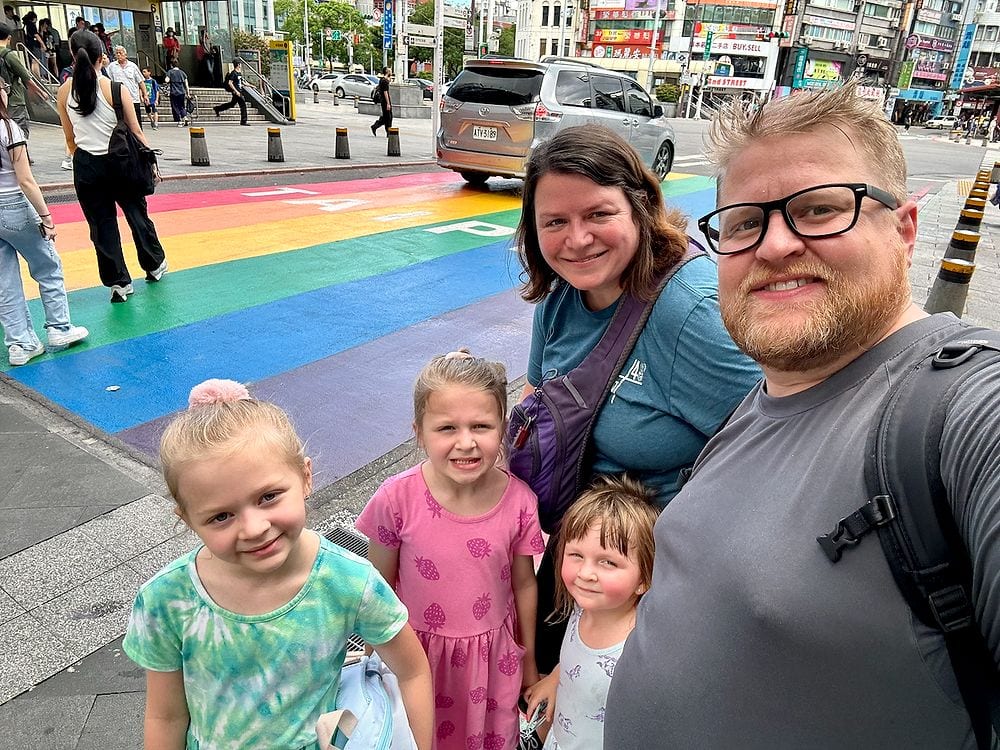
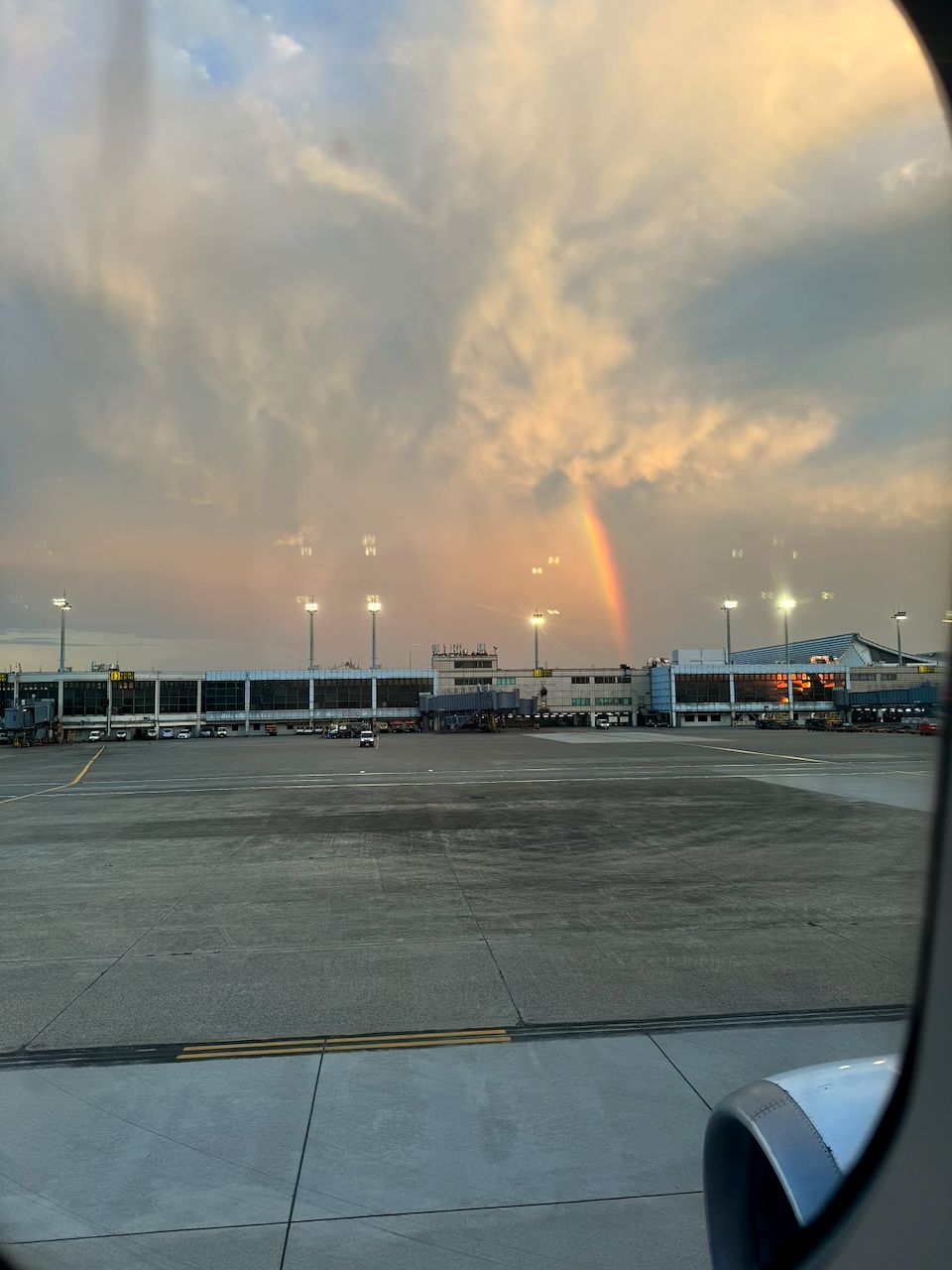
Two weeks later, Taiwan sent us off with a rainbow over the tarmac. I'm not being sentimental about it. I have the photo. It's one of the best photos from that year.
This is the guide for families thinking about Taipei, worldschooling families especially, people with a budget, people who want to do it right, and anyone who has ever eaten a soup dumpling and immediately wanted their whole life to be soup dumplings. We spent 13 days here across July 2024 with Lily (then eight), Cora (seven), and Harper (five), running a $300 USD per day budget for a family of five. We filmed the whole thing for our YouTube series if you want to watch it rather than read it, but if you're the reading type, here's everything.

The Basics: What You Actually Need to Know Before You Go
Taiwan uses the New Taiwan Dollar. The exchange rate is roughly 30 NTD to 1 USD, which means prices that look large in local currency are usually pretty reasonable once you do the math. A bowl of noodles runs about 150 NTD, which is five dollars. Beer at a night market is 50 NTD. A metro ride downtown for two adults and two older kids cost us about 80 NTD total. The cheapest week of food we've had in Asia, and the food was genuinely excellent.
The plug situation is one of those things nobody mentions: Taiwan uses Type A outlets, the same two flat parallel pins as the United States. No adapter required. Coming from Japan we didn't even notice the transition, but if you're coming from Europe or Australia this is worth knowing before you pack.
The summer heat is not a rumor. It was 34 degrees Celsius most days, and the app said it felt like 40. It rains every single afternoon, usually around 2pm, usually for about 45 minutes, usually accompanied by the kind of sky that makes you want to be somewhere with a roof. Bring umbrellas. We did not bring umbrellas often enough. This became a running joke by day three and a genuine inconvenience by day six.
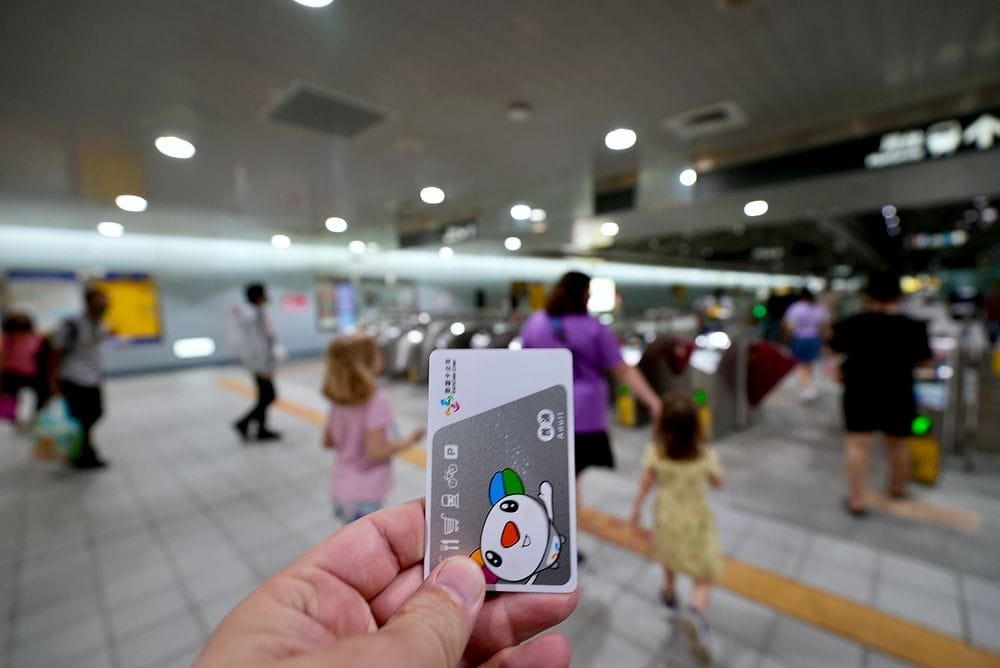
The Easy Card is your friend. These are tap-to-pay transit cards you load with cash and use on the metro, buses, and some convenience stores. They cost 100 NTD to get and you reload them at the machines at any station. Kids five and under ride free on the metro. Kids six to eleven are half price on buses and full price on the metro, so the math on which to take changes a little depending on your family configuration.
Where We Stayed: Ximending
There's a school of thought that says don't book somewhere too nice or you'll never want to leave. We went the other direction and booked an Airbnb in Ximending, which is the area of Taipei sometimes compared to Harajuku in Tokyo. Young, vibrant, full of street food and fashion and things going on at midnight when you're trying to sleep.
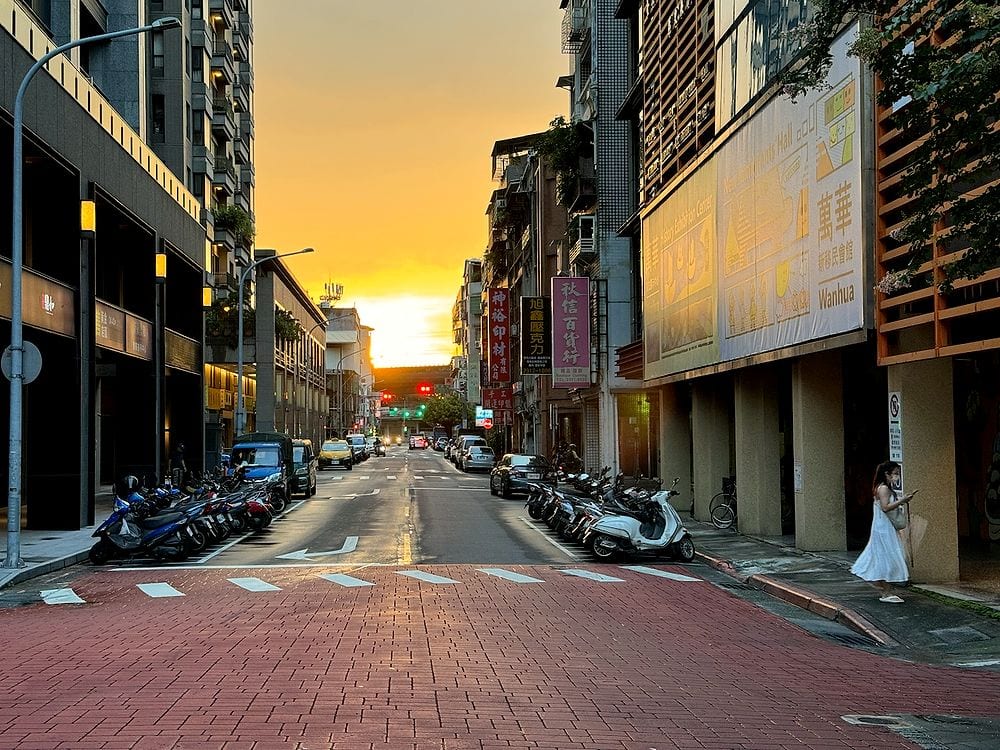
We paid about 62 USD per night. Right next door was a 24-hour beef noodle place that always had people in it. Across the street was a witch café. The neighborhood runs on scooters and neon, and the walking street down the middle is genuinely great at night.
For a family of five doing worldschooling, this location made sense. Everything accessible by transit. Night markets walking distance. 7-Elevens and FamilyMart every half block for snacks, drinks, and the occasional emergency ice cream.
If you're not into the chaos, the quieter neighborhoods work fine too, but for us, being in the middle of it was the right call.
Our Itinerary
8 Days in Taipei, Taiwan
Temples, night markets, geology, soup dumplings, and one very well-timed rainbow. July 2024 with three kids on a $300/day budget.
Day
1
Arrival & City Tour
Landed at Taoyuan, checked into Ximending, hit the Grand Hotel, National Palace Museum, Lungshan Temple, and Taipei 101 in one big guided day.
Day
2
Northern Taiwan Day Trip
Yehliu Geopark, Jiufen Old Street, the Golden Waterfall, Yin Yang Sea, and sky lanterns at Shifen. One of the best days of the whole trip.
Day
3
Metro, Parks & Night Markets
Traditional breakfast, Easy Cards, a park made entirely of slides, the underground mall, and three night markets back to back.
Day
4
Science Museums
The National Taiwan Science Education Center and Taipei Astronomical Museum. Escalators with see-through panels, a pregnancy suit, and a bike with square wheels.
Day
5
Cooking Class & Din Tai Fung
Made xiaolongbao, bubble tea, and smashed cucumber salad from scratch. Then went to Din Tai Fung that same night to compare. Ours held up.
Day
6
Taipei Zoo & Gondola
Took the crystal-floor gondola to the south entrance and walked downhill all day. Pandas, otters, koalas, and a 2pm rainstorm right on schedule.
Day
7
Raohe Night Market
The best night market in Taipei. Pepper buns from the clay oven, pan-fried pork buns, IPAs at the craft beer spot. Two full laps and we still missed things.
Day
8
Museums, Memorials & Goodbye
National Taiwan Museum, the 228 Peace Memorial Park, the Discovery Center of Taipei, and a rainbow over the tarmac at Taoyuan on the way out.
Day 1 Tour: The Grand Hotel, National Palace Museum, Lungshan Temple, and Taipei 101
We took a guided city tour on day one. I'll be upfront: we usually skip tours because they're expensive and you spend half the day waiting for the slowest person in the group. This one was different, and I think it came down to our guide, Kiara, who was genuinely excellent at explaining context that would have taken us hours of reading to find on our own.
The Grand Hotel is one of those places that requires no photography skills because it photographs itself. A massive Chinese imperial-style building perched on a hill surrounded by jungle, built to host foreign dignitaries, with reportedly over 300,000 dragons worked into the décor. The girls immediately wanted to count them. We did not have that kind of time.
The National Palace Museum is the one that hits you. It houses over 600,000 artifacts, most of them from the Chinese imperial collection that was moved out of Beijing in 1948 as the Communist Party gained ground in the civil war. Over 5,000 shipping containers of Chinese history, brought to Taiwan and kept here. You could spend a week in this museum. We had two hours and barely scratched the first floor. The jadeite cabbage, which is the famous one, was on loan to another museum when we visited. We got to see the photo. The meat-shaped stone was there, which is a piece of jasper that looks exactly like a glazed piece of pork belly, and the detail is extraordinary. The guide told us the shape was entirely natural and only the surface was treated slightly. If you didn't know, you'd think it was food.
The stamping stations are everywhere in Taipei and the girls had their journals with them. If you're traveling with kids who keep journals, this matters: almost every major attraction has ink stamps you can use, and by the end of the week they had pages full of them.
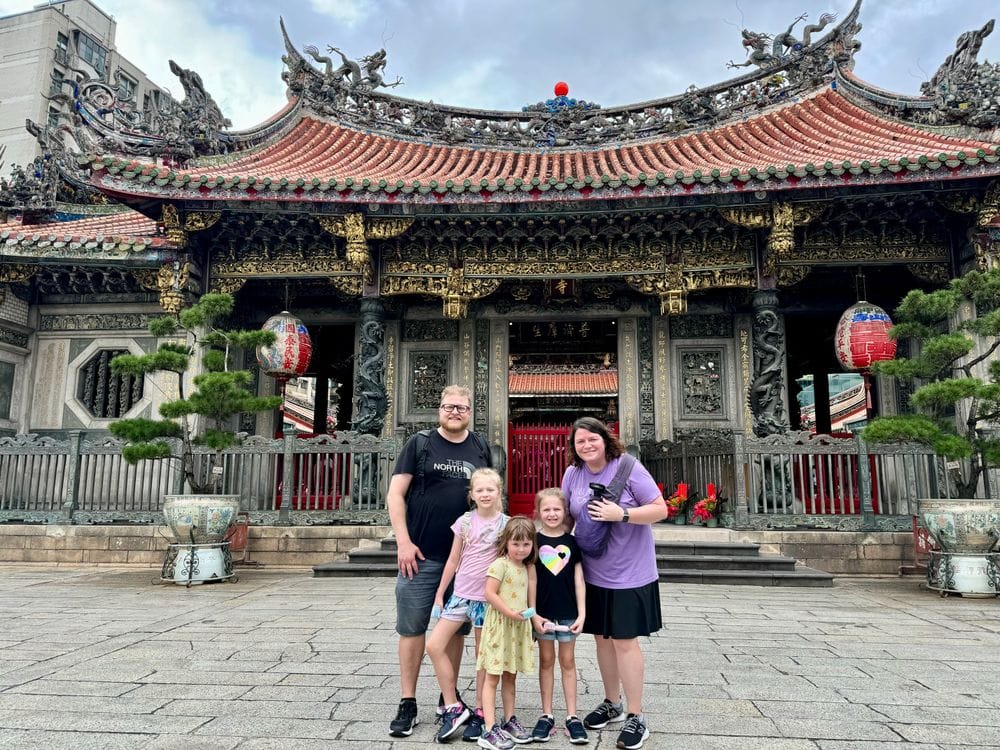
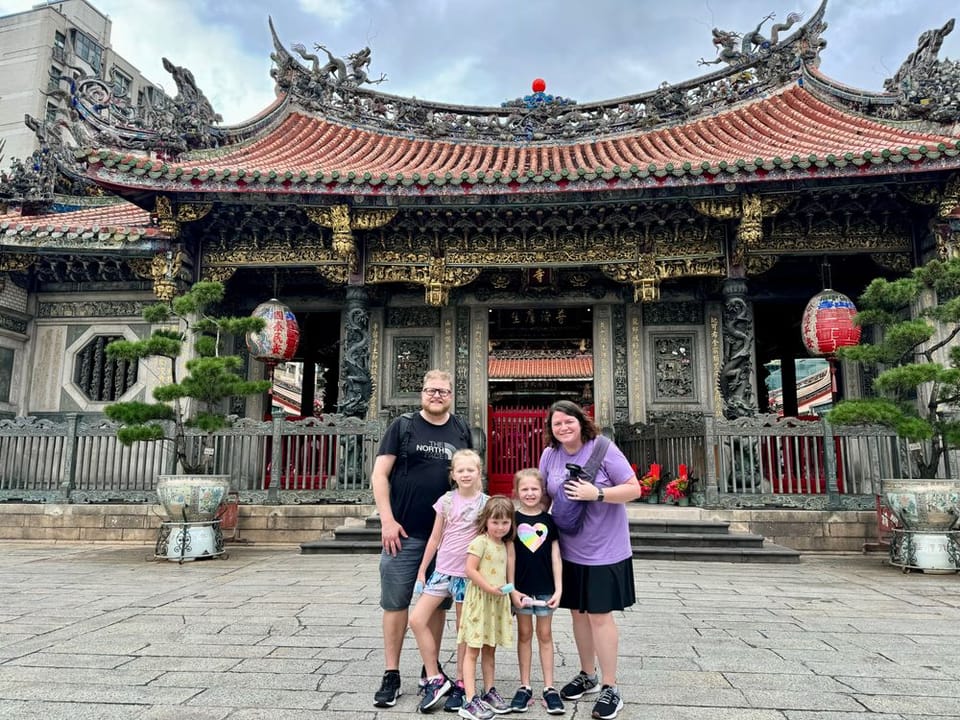
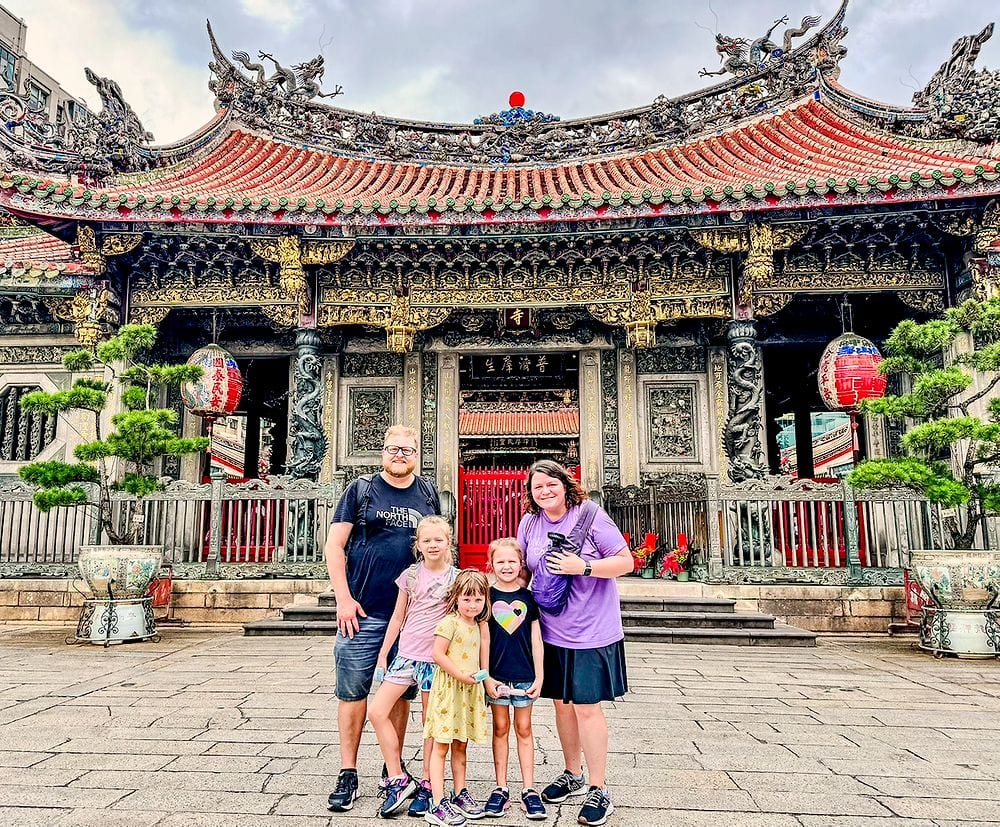
Lungshan Temple is the oldest and most active temple in the city. We were there during a busy afternoon and Kiara showed us the moon blocks, which are the pair of red wooden pieces used to ask the gods yes or no questions. You state your name, your birthday, where you're from, then ask the question and throw the blocks. One flat side up, one round side up means yes. Both round sides up is no. Both flat sides up is the "laughing gods," which means you asked something silly and should try again. We got a yes on something. I don't remember what we asked. I remember being weirdly happy about it.
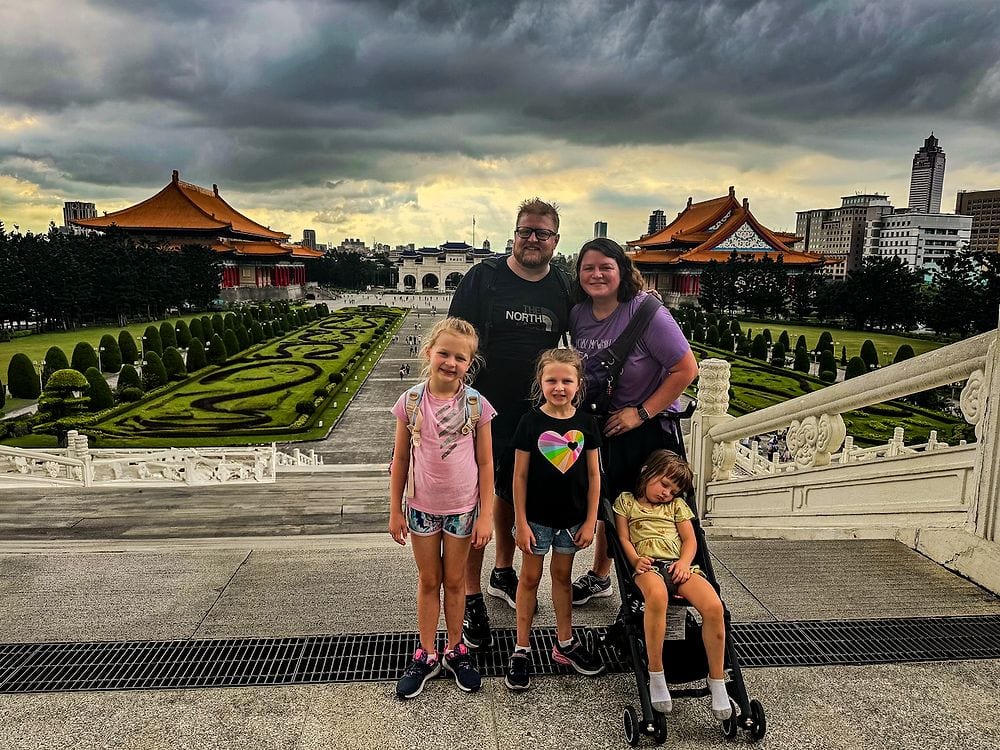
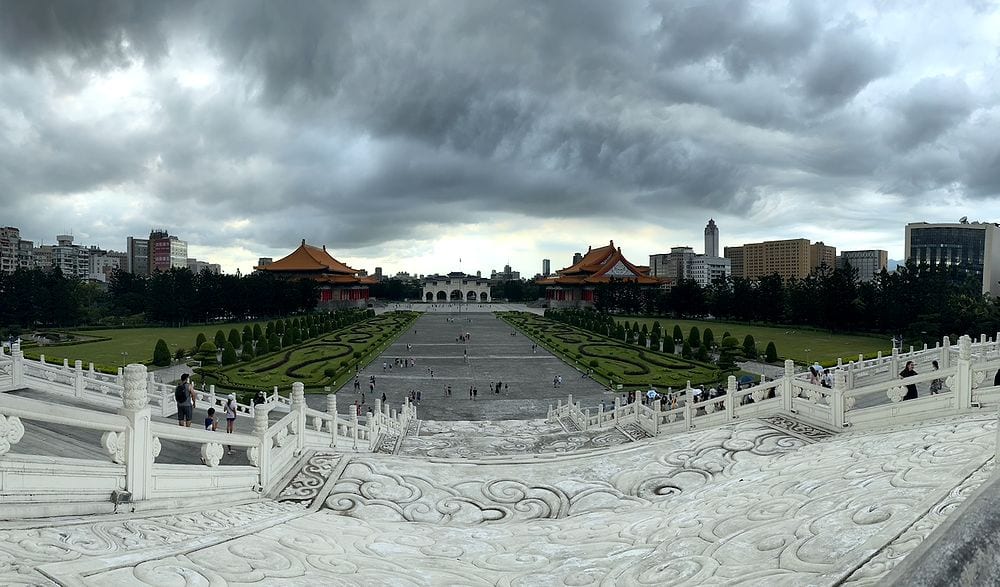
Chiang Kai-shek Memorial Hall is enormous in a way that takes a moment to absorb. The building is white marble, the roof is blue, and there are 89 steps to the main platform, one for each year of his life. The changing of the guard ceremony draws a crowd. The girls had been looking forward to it and it delivered. Precise, formal, worth watching.
Taipei 101. Formerly the tallest building in the world. You look at it and you understand why it was on every architectural wallpaper from 2004 onward. I've known about this building since I was a kid. Seeing it in person, especially at night, is one of those things that lands differently than expected.
Day 2: Northern Taiwan – Yehliu, Jiufen, Shifen, and Sky Lanterns
This is the day trip. Book a driver, get out of the city, do this.
We used a ride-share app called Tripool for a full-day driver and it came out to just under 5,000 NTD for the van for the day. For a family of five, splitting that cost over the whole day across multiple stops, it's genuinely competitive with other options and infinitely easier than figuring out regional buses with three kids.
Yehliu Geopark is on a cape that sticks about two kilometers into the sea. The rocks are limestone and sandstone that erode at different rates, which leaves formations that look like something out of a bad CGI movie. The Queen's Head is the famous one, though the wait for a photo with it was about 45 minutes in the direct July sun and we skipped it. The rest of the park is beautiful. Clear water, strange rock shapes, a wonderful sea breeze, and then the shade runs out and the sun hits and you need water immediately.
The worldschooling angle here is erosion and geology, and it landed well. We'd been talking about how water shapes rock, and seeing formations where you can literally trace the flow lines with your finger made it tangible in a way a textbook never does. This is what worldschooling actually looks like most of the time: not a formal lesson, just a place that makes a concept real.
Jiufen is the one that's famous for the Spirited Away connection, though the filmmakers have never officially confirmed it and the debate continues. What is definitely true is that the winding hillside alleys, the tea houses perched over the valley, and the red lanterns at dusk look very much like the spirit world from that film, and the girls knew exactly what they were walking into. We ate at a restaurant with noodles and edamame and Taiwan beer while the girls watched lantern-lit alleyways through the window, and it was one of the best meals of the trip.
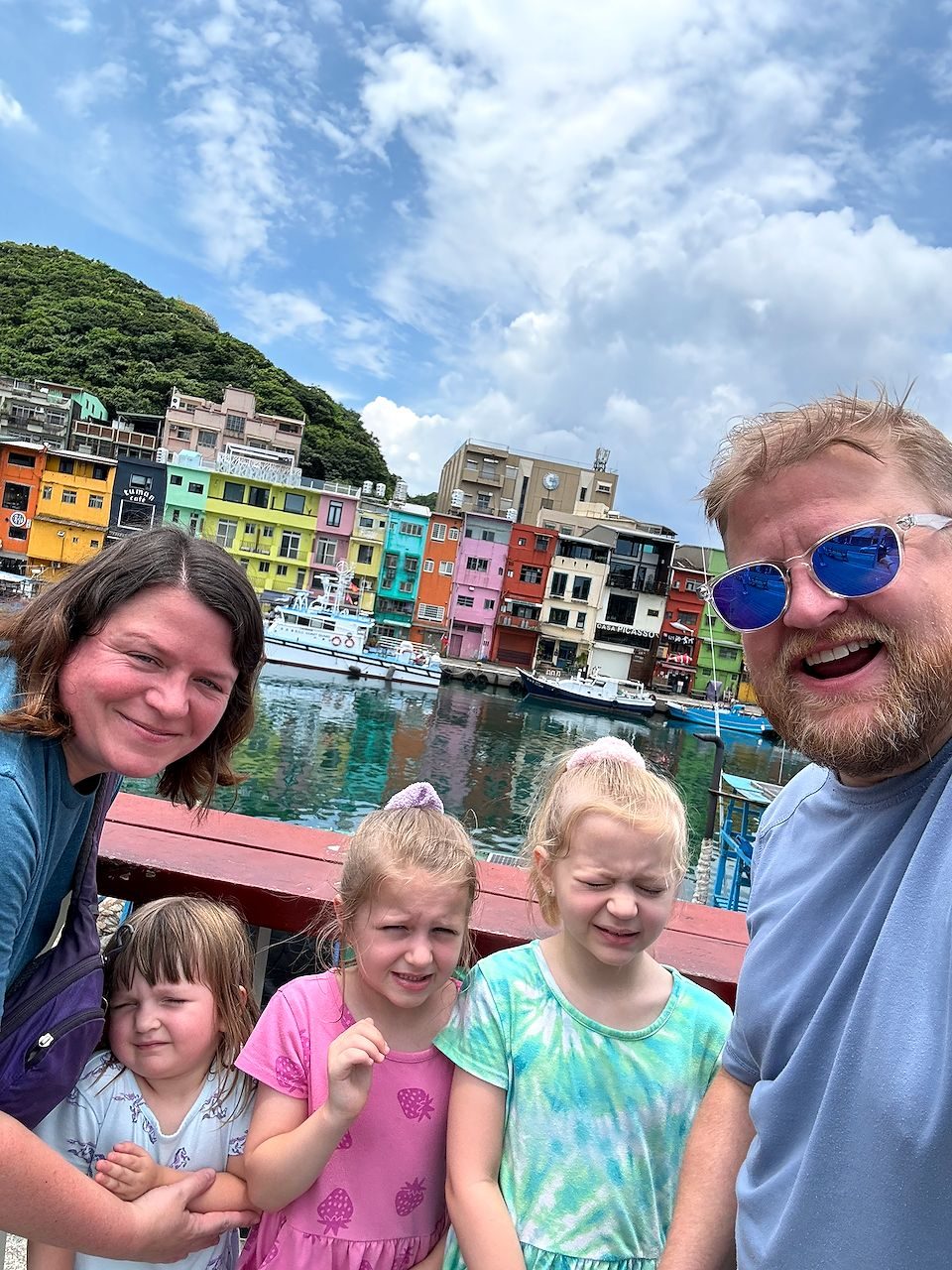
The Golden Waterfall on the way back down from Jiufen gets its color from the mineral content of the water: sulfur, copper, arsenic. It's beautiful. You're not swimming in it. The Yin Yang Sea is where the golden waterfall water meets the regular ocean at the bay, and you can see the two waters meet from the viewing platform. One side is blue, the other has that golden mineral tint. It's genuinely one of the more unusual things I've photographed.
Shifen is the sky lantern town. You write on the lantern with traditional brushes, each color represents something different, you light the fuel, and it floats off into the sky. We've done this once before and it's one of those things that feels slightly silly to describe in a sentence and is legitimately beautiful when you're doing it. The girls decorated the lanterns with names, wishes, and an amount of paint that concerned me re: their clothes.
The old town at Shifen is a train-street market, meaning a real active train runs through the middle of the shopping street, a few inches from the stalls on either side. It goes about twice an hour and everyone shifts back to let it pass. Absurd, wonderful, very much worth the trip.
Day 3: Metro, Parks, Underground Malls, and Night Markets
This was what I'd call a light logistics day, which in Taipei means you still cover a lot of ground.
We started with a traditional Taiwanese breakfast at Yong He Soy Milk, which is one of those places that usually has a line from opening until noon, and when you come at noon it has a QR code menu with pictures. We got fried bread, bun omelets, and dumplings for 50 NTD. The bun omelet is a chive and egg omelet in the softest bun you've ever had. We ended up going back almost every morning after.
New Taipei Metropolitan Park is built in a flood plain. Instead of leaving the flood control slopes empty, they covered them in slides. There are hundreds of slides of varying lengths and steepness all over the hillside. As soon as we came up from the metro, there was a slide instead of stairs. The girls lost their minds. The sun was brutal and the water play area was closed and we eventually retreated, but the concept of this park is so good that it deserves mention anyway.
Taipei City Mall is the largest underground shopping street in Taiwan and connects multiple train stations including the high-speed rail. When it started pouring on us outside, which it did, the mall became a two-hour escape into climate-controlled consumerism and figurine shopping. It's a maze. We got turned around constantly. We did not mind.
The night markets south of Ximending were three separate ones that link end to end: Bangka Old Street, Wanhua Night Market, and Guangzhou Street Night Market. The Wanhua one used to be called Snake Alley, which tells you something about its history. These markets were more local and less busy than the one we'd do later in the week, but the scallion pancakes made with linseed and millet were worth the walk by themselves. She cracks an egg into the batter right on the griddle and throws basil in. I can't explain how good it is. Just go find one.
Day 4 & 5: Science Museums, Planetarium, and Cooking Class
Two back-to-back days I'd put in the worldschooling highlight reel.
The National Taiwan Science Education Center is one of those museums built for children by people who actually thought about what children want to do in a museum. The escalators have clear panels so you can see the counterweights moving. There's a human body exhibit where the girls tried on pregnancy simulation suits and walked through a digestive system that exits through a wall-mounted butthole, which I will not pretend was not the highlight for them. There's an electronics section, a physics area with a bike that has square wheels, gyroscope experiments, and a demonstration where a kid lifts a car with a pulley system. We were there for over an hour and a half and made it through half of it.
For me specifically, walking through the electronics section with the girls was one of those worldschooling moments I wasn't expecting to feel. I've worked in this field. I know this stuff. Getting to explain it to kids who are curious and engaged, in the middle of a Taiwanese science museum, is one of those things that doesn't translate into a vlog very well but stays with you.
The Taipei Astronomical Museum is worth the Dome Theater ticket on its own. Each floor covers a different layer of space, from the moon landing at the bottom through planets, stars, and deep space as you move up. There are interactive games, huge scale models, and a water bottle rocket launcher outside.
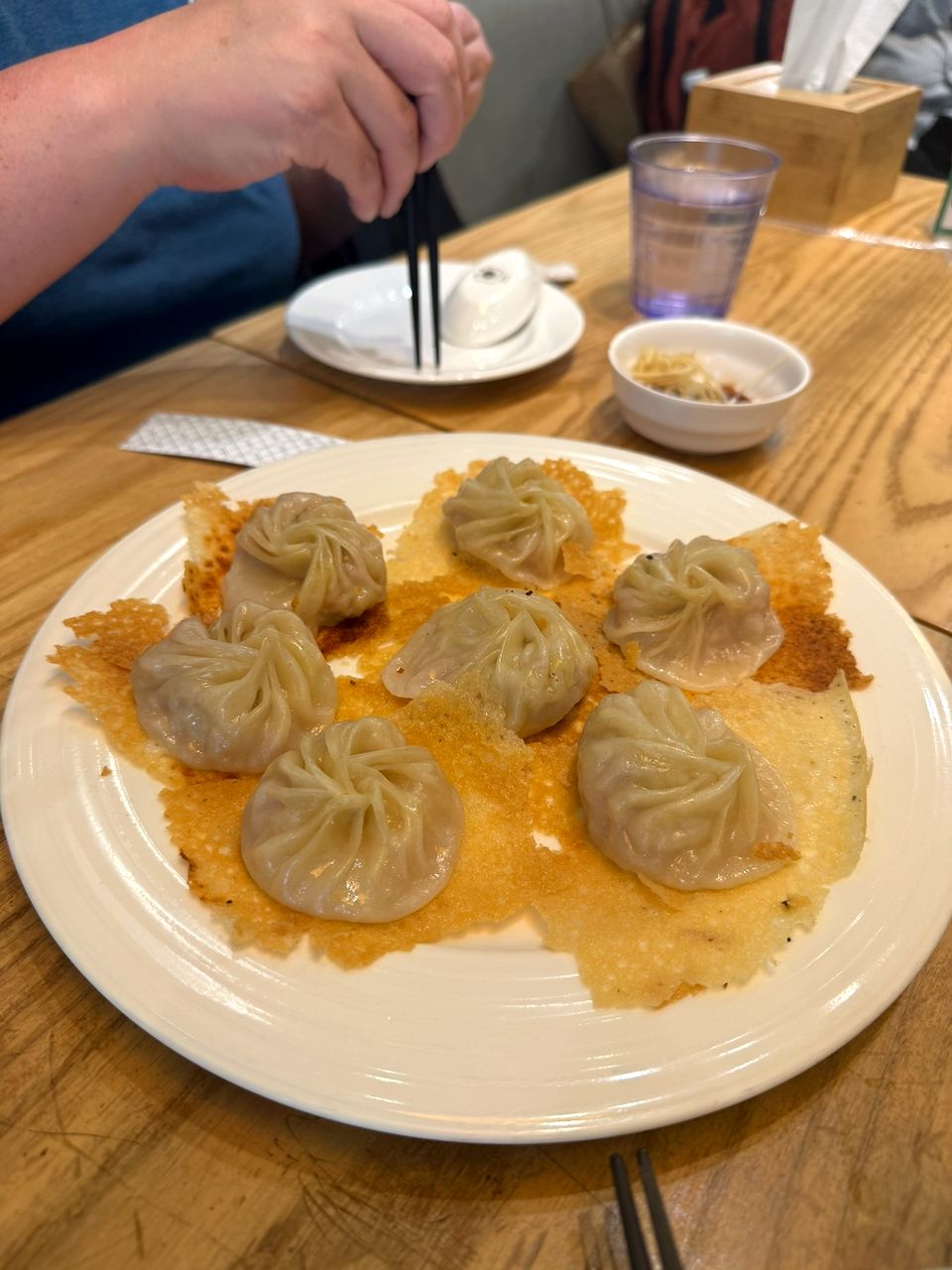
The cooking class was maybe the single most memorable experience of the whole trip. We signed up for a two-hour session to make xiaolongbao, bubble milk tea, and smashed cucumber salad. The soup dumplings have a secret filling. I was told I cannot share it. Our instructor, Diana, made pleating look effortless: pinch fold, pinch fold, pinch fold, twist, done, in about four seconds. Mine looked like sad deflated footballs. The girls were actually good at it, which is humbling. We steamed our dumplings, made the boba, plated the salad, and ate all of it, and then that same night we went to Din Tai Fung, which is the world-famous xiaolongbao restaurant founded in Taipei, and compared them. Ours were honestly comparable. I'm still proud of that.
Day 6: Taipei Zoo and the Gondola
One of the best zoo days we've had anywhere.
The practical tip first: take the gondola from the metro station to the south entrance and walk downhill all day. The zoo is built into a jungle hillside and if you enter from the top and work your way down, you're constantly on a mild descent rather than grinding uphill in the heat. We did this and it worked perfectly.
The gondola itself is the Maokong Gondola, and when you get on you can choose between regular cabins and crystal cabins. The crystal cabins have glass floors. Lindsay did not enjoy the glass floor. The girls loved the glass floor. I thought it was great. Taipei 101 keeps appearing in the distance as you glide through the treetops, doing its job as the city's orientation landmark.
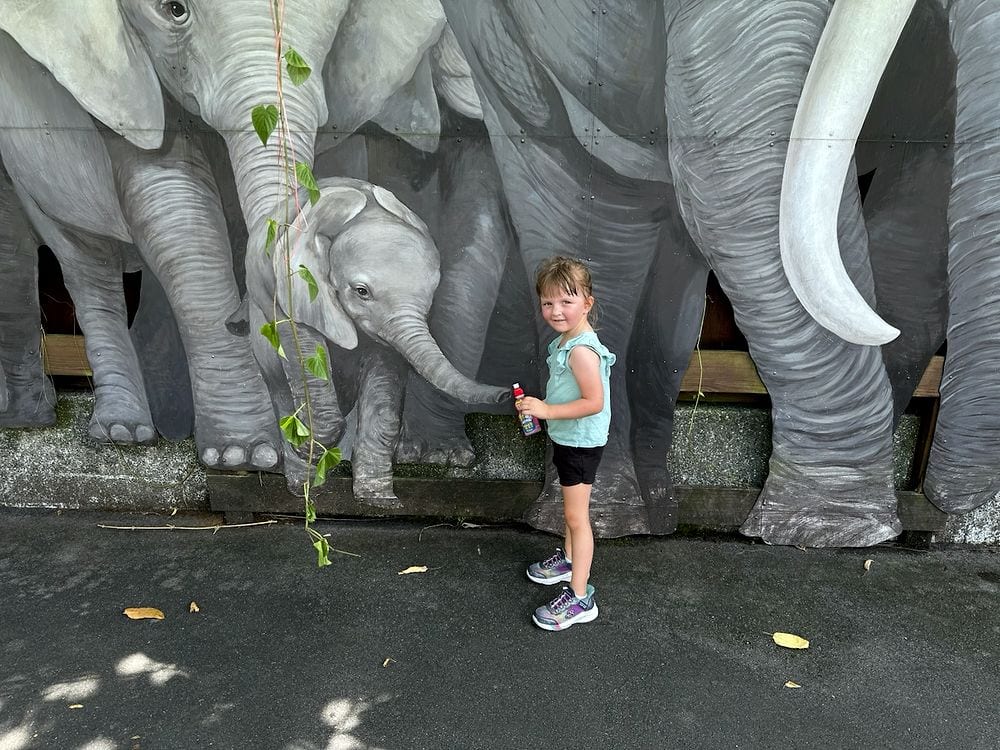
The zoo is massive by any standard and cheap: 320 NTD for two adults and two kids, with Harper free. There are 7-Elevens inside the zoo with non-inflated prices, which is a design decision I respect enormously. We saw reptiles, penguins, bears, wolves, big cats, rhinos, gorillas with a baby, hippos, giraffes, river otters (Lily's favorite animal, found), pandas that were actually awake and active rather than sleeping in a corner, and koalas that were also awake, which Lindsay said was the most active koalas she'd ever seen.
It rained at 2:22 PM. I have the timestamp because I filmed myself noting we'd forgotten umbrellas again. We made a run for the koala building and watched them eat eucalyptus leaves while the storm passed. It always passes.
The Best Night Market: Raohe Street
If you do any research at all on Taipei night markets, Raohe Street comes up. There's a reason for that.
We'd been to three or four other night markets by this point, and they were good, but Raohe is a different level of busy and a different level of choice. It's at the end of the green metro line, covered in places, packed with food stalls, games, clothes, shrimp fishing, mahjong parlors, and a craft beer spot with IPAs where you can sit down and eat whatever you collected from the rest of the market.
The pepper buns are the famous item. They're called Huzhou Bing and you find them by the line. Dough stuffed with minced pork and green onions, slapped to the inside wall of a cylindrical clay oven, cooked from the inside out. They hand it to you in a paper bag so hot you need to wait before you can hold it properly. We got three and ate them in about 90 seconds.
The pan-fried buns were the other one that got us. Pork-filled, cooked on a flat iron, eight to an order for 130 NTD, served with sauce and so much steam that you have to just wait and suffer until you can eat them. "They're like little miniature buns" is how I described them on camera and I stand by that as an accurate if unpoetic description. They're so good.
Sweet potato balls. Scallion pancakes with egg cracked in. Sanrio character molded pancakes for the girls. Sugarcane juice pressed right in front of you. The market is two long rows and you walk one side, turn around, walk back the other side, and by the end you've spent less than 20 USD and eaten enough for a family of five plus snacks.
The Last Day: 228 Peace Memorial Park and the Discovery Center
We ended the trip in a more reflective mode, which felt right.
The National Taiwan Museum is one of those hidden gems that doesn't make every top-ten list but probably should. It's a beautiful neoclassical building from 1908, the colonial period, compact enough to do in two hours, and at 90 NTD for our whole family (Harper free), basically free. There's a basement kids area with interactive exhibits, a dress-up area with traditional Taiwanese clothing, and a rocks and minerals exhibit that connected back to our geology worldschooling day at Yehliu. The girls were pulling out specific rock names. That moment is why we do this.
The 228 Peace Memorial Park is right behind the museum, and the memorial itself is worth stopping for regardless of how much history you come in with. On February 28th, 1947, a government crackdown on local Taiwanese protesters following a dispute with a street vendor turned into a months-long period of mass arrests and killings. Thousands died. Intellectuals and community leaders were specifically targeted. The event was suppressed entirely under martial law for nearly four decades. Taiwan formally acknowledged and apologized for it only in the 1990s, after the transition to democracy.
We travel through a lot of memorial sites. There's always a version of the same hard thing: human beings doing catastrophic things to other human beings, and then trying to build a park around it so we don't forget. We talked about it with the girls at their level. It's part of how we travel.
The Discovery Center of Taipei is free, inside City Hall, closes at five, and you need about an hour. It's interactive, hands-on, and the girls got stamps.
Budget Breakdown: $300 USD / Day for Five
We tracked this in the video series. The short version: Taiwan is one of the cheapest countries in Asia to travel as a family when it comes to daily expenses. Food is cheap, transit is cheap, most museums cost almost nothing. The budget pressure came from accommodation (harder to get five people into a nice space cheaply) and the occasional splurge, like the IPA at Raohe Street that cost 300 NTD for a 400ml pour and was absolutely worth it.
Ticket prices to know: National Palace Museum 350 NTD adults, kids 17 and under free. Taipei Zoo 160 NTD adults, 80 NTD kids. National Taiwan Science Education Center about 100 NTD adults and 70 NTD kids. National Taiwan Museum 30 NTD adults, Harper free. Discovery Center of Taipei, free. Maokong Gondola, included with Easy Card.
The cooking class runs about 2,200 NTD per person. We found it genuinely worth it for the experience, not just for the xiaolongbao.
When to Go (Not July)
February to April and October to December. The guide at the Discovery Center confirmed this and so did several locals over the two weeks. Summer is hot, humid, and has afternoon storms every single day. It was manageable, it produced some genuinely dramatic sky photos, and we're glad we went, but if you have flexibility, fall or spring will be a lot more comfortable. The mountain trails around Taipei, which we never made it to and still regret, would be entirely different experiences in cooler weather.
The Honest Summary
Taiwan surprised us. Not because we expected it to be bad, but because we hadn't had proper expectations at all. We came in knowing roughly nothing about what daily life felt like there, and by day four we were talking about coming back. By day eight we meant it.
It's a city that is somehow simultaneously ancient and modern, dense and green, chaotic and efficient. The food costs almost nothing and is excellent at every price point. The public transit works. The people were kind in a way that felt genuine rather than performed. The history is layered and complicated and worth engaging with rather than skipping past.
The girls learned about erosion, Chinese history, Taiwanese sovereignty, basic food production, engineering, astronomy, and how to make soup dumplings. They stamped their journals at every museum. They got soaked three different times when we forgot umbrellas.
We filmed the whole trip across five episodes on YouTube. We covered it in our guidebook if you want the printable reference version. And now we're living in Da Nang and thinking about how Taipei is only a short flight north.
Come here. Come in the fall. Bring umbrellas.
If you'd rather watch than read, we put together a full supercut of the entire Taipei trip in one sitting. Every day, every meal, every time we forgot an umbrella. It runs about an hour and covers everything in this guide plus some moments that didn't make the individual episodes. Good for a long flight, a rainy afternoon, or anyone who just wants to see the city before they decide if it's worth the trip.
Some links on this page may earn us a small commission. It never changes what you pay, and we only recommend things we actually use.