


It was 3pm in our Da Nang apartment, with a 4:30pm flight to Shanghai via Hong Kong. The plan was to use China's 240-hour visa-free transit to finally see a country we had been circling for years. Eight days later we walked away convinced that China is far more workable for families than most people assume.
Here is what we learned about connectivity, payments, and logistics for visiting China with kids, including our own run through the 240-hour visa-free transit and what we would do differently.
Understanding China's 240-hour visa-free transit
China's 240-hour transit, officially called Transit Without Visa, lets citizens of 55 eligible countries stay up to 10 days without a visa, as long as you enter from one country or region and then leave to a different third country or region rather than returning to where you came from. As of 2026 it runs at 65 ports of entry across 24 provinces and municipalities, a big expansion from the handful of city clusters that were in place when we went. Many nationalities now also have a separate 30-day visa-free entry option, so check which one fits your trip before you book.
At airline check-in, use the phrase "Transit Without Visa," not "transit visa." Staff sometimes ask for a physical visa document you do not have and can deny boarding if the wording confuses them.
Our transit route strategy
We flew Da Nang to Hong Kong to Shanghai to Tokyo, which met the third-country requirement because we entered from Hong Kong and departed to Japan. Immigration recorded the transit as HKG to PVG to NRT, confirming that Hong Kong and Japan count as the two different regions on either side. Hong Kong, Macau and Taiwan are all treated as separate destinations for this purpose.
Avoid a Hong Kong layover on both the inbound and outbound legs. If Hong Kong sits on both sides of your China stop, you can fall foul of the third-country rule.
Arriving at Shanghai Pudong without a visa
We landed at 11:55pm with nothing prepared beyond printed itineraries and onward flight confirmations, and immigration took about 90 minutes. The mistake that cost us time: we first filled out the standard arrival forms, which are wrong for 240-hour transit passengers, and with no staff around at that hour we had to start over. Look for the two-part forms with a detachable departure-card section at the bottom, which are the correct ones for visa-free transit.
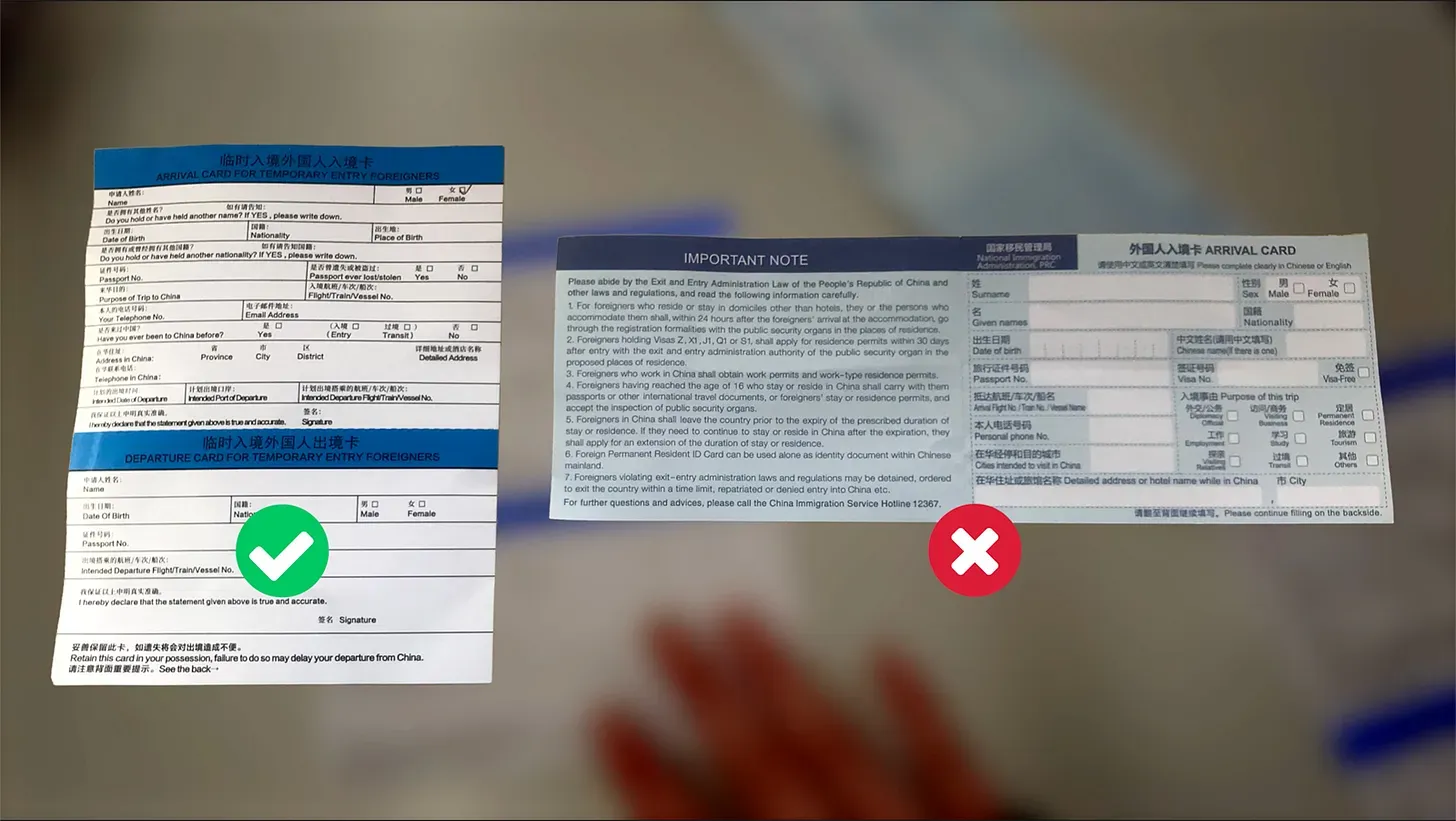
Bring a passport valid well beyond your dates, the official minimum is three months and we would not travel on less than six, a confirmed onward flight to the third country, a printed itinerary for the whole journey, and your accommodation details in China. The officer went through our Tokyo departure flight closely before approving the stay. There is no advance application and no fee.
Internet connectivity in China: what actually works
China's internet restrictions make reliable data essential for maps, translation, and staying in touch. We tested several options across our eight days in Shanghai, and the full write-up of that test lives in our Shanghai Holafly review.
The eSIM with a built-in VPN worked best
The Holafly China eSIM was the one thing that consistently got us past the Great Firewall, because the VPN is built into the plan and routes traffic out through Singapore or Hong Kong automatically. The blocked apps loaded on arrival with nothing to install. If you are deciding what to buy, we put the full comparison and current pricing in our best eSIM for China guide.
Why our standalone VPNs failed
We brought both ExpressVPN and NordVPN as backups and hit real limits. Our Shanghai rental had a monitoring device that cut all internet the instant it detected VPN use, with no delay or warning. On mobile, both services connected only occasionally and dropped within minutes. The eSIM with the VPN inside the plan was the only setup that held.
| Solution | On mobile | On rental Wi-Fi |
|---|---|---|
| Holafly built-in VPN | Reliable | Reliable |
| ExpressVPN | Unreliable | Blocked |
| NordVPN | Unreliable | Blocked |
Essential apps for China travel
Download and set these up before departure, while you still have open internet.
- Alipay: payments, transport, and food delivery
- Amap: Chinese navigation with solid English labels
- Apple Translate: works offline for basic communication
- WeChat: needed for some restaurant ordering systems, and locals call it "Weixin"
Without a working VPN, expect Google Maps, Gmail and Google Translate, WhatsApp, Facebook and Instagram, YouTube and most Western news, and many international banking apps to be blocked.
Payment solutions that actually work
Alipay is your digital wallet in China
Setting up Alipay with international cards changed the trip. We never touched cash across the full eight days. In our testing a Chase Visa debit card and a Schwab Visa debit card both linked and worked.
With it you can pay at restaurants, shops and street vendors, order Didi rides, buy metro tickets, and get food delivered. To set it up, download the app before you leave, verify your phone number, add an international debit card, and complete the identity verification.
WeChat Pay as a backup
We set up WeChat Pay before departure but needed it only once, for a restaurant whose ordering system was built around it. Most places take Alipay as the primary method. When you ask about it, say "Weixin," since locals often do not recognise the name WeChat.
Family activities in Shanghai
A first-day orientation tour with Jenny's Tours gave us the cultural context and the lay of the land, which helped for a first visit with kids. The Lost Plate breakfast food tour became our favourite thing we did in the city, and code ADAMANDLINDS gets a discount on Lost Plate tours. Shanghai Disney was a hit, with noticeably shorter lines than other Disney parks we have done.
On language and navigation, Apple Translate was fine offline, and Shanghai has a lot of English signage in tourist areas. Google Maps needs a VPN, so we leaned on Amap, which handles the local restrictions and reads clearly in English.
Internet access for extended stays
If you are staying longer than 30 days, a Holafly Plans subscription usually beats buying back-to-back 30-day eSIMs, and it keeps the built-in VPN behaviour that makes China access work.
Light Plan
$49.90/month
25GB across 160-plus destinations
For lighter data users on a longer stay.
See the Light PlanUnlimited Plan
$64.90/month
Unlimited data across 160-plus destinations
Built-in VPN and hotspot included.
See the Unlimited PlanPractical tips for families
Before departure
Write up an itinerary that lists what you are doing, where you are staying, and above all when and how you are leaving, since that onward flight is what the officer checks. Print flight confirmations, hotel bookings and emergency contacts. Download offline maps, translation, and entertainment for the kids. Finish Alipay verification while you still have unrestricted internet. And buy your China eSIM and install it at home, using code ADAMANDLINDS for 5% off.
Upon arrival
Fill out the two-part arrival and departure card, not the standard form. Turn on data roaming for the eSIM so you are online immediately. Test an Alipay payment at the airport. Make sure Amap is downloaded for navigation without Google Maps.
During your stay
Keep a little cash for emergencies even though we never needed it, screenshot the important details in case of a connectivity gap, and stay flexible, because speeds vary and patience helps with kids in tow.
Cost breakdown for China connectivity
A standalone VPN service runs roughly $10 to $15 a month and gave us variable, often blocked results in China. An eSIM with the VPN built into the plan cost more but delivered consistent access, which on a short trip is the thing that actually matters. For current Holafly China eSIM pricing by number of days, and how it compares against a local SIM, see our best eSIM for China guide. For stays past a month, the monthly Plans subscription is usually the cheaper route.
Common China travel questions
FAQ
China travel questions, answered
Holafly's China eSIM uses China Mobile's network, with excellent coverage in major cities like Shanghai, Beijing and Guangzhou. Rural areas can be slower, but urban coverage was strong throughout our stay.
Each device needs its own eSIM, but the hotspot feature lets you share the connection with kids' Wi-Fi-only devices.
Yes. No advance application or fee. You complete the forms on arrival and receive a 10-day stamp, as long as your routing meets the third-country requirement.
The Holafly China eSIM's built-in VPN reconnects and switches servers on its own. Because it is part of the data connection rather than a separate app, it held up better than the standalone VPNs we tried.
No. There is no extension. You must leave China within the 240-hour window or face overstay penalties.
We finished the entire eight days without using cash once. Alipay acceptance is close to universal, from street vendors to large stores.
Download offline maps and keep emergency contacts handy. The eSIM held its connection even at busy times.
Shanghai felt very safe for family travel. Crime is low, public transport is excellent, and people were helpful with our children.
Planning your China trip
China turned out to be one of the easier places we have taken the kids once the logistics were sorted. The eSIM with the built-in VPN for access and Alipay for payments removed the two things that put most families off, and the 240-hour transit made the whole thing possible without a visa. For the connectivity choice specifically, our best eSIM for China guide covers what to buy, and the Shanghai review covers how it held up day to day.
If you want a hand building a family-friendly China itinerary, Lindsay plans these through our travel advisory at [email protected].
This post contains affiliate links. If you purchase through our links or use code ADAMANDLINDS we may earn a small commission at no extra cost to you, and you get the stated discount. Holafly is our exclusive eSIM partner and we pay for the products we write about. All opinions are based on our own family trip to Shanghai.