
Keeping five people online across a dozen countries a year is its own logistics problem. We travel full time with our three daughters, and we have used travel eSIMs across Europe and Asia since 2022 to do it, working, homeschooling, and finding our way around new cities on the same data plan. This guide is the family-of-five version: what we actually run, how one line covers everyone, and how to pick between a per-country eSIM and a monthly subscription.
We have used Holafly, Airalo, Airhub, Nomad, and SimLocal on real family trips, so the picks below come from using them, not reading spec sheets. Prices and coverage in this guide were checked in August 2026; both move around, so confirm on each provider's site before you buy.
The single most useful thing to understand first: there are two different kinds of product here, and mixing them up is what makes eSIMs confusing. Destination eSIMs and global subscription Plans solve different problems. Here they are, kept apart.
Destination eSIMs vs global subscription Plans
A destination eSIM is a one-off data pack for a single country or region. You buy it for the trip, install it, and it runs until the data or the days are used up. It is data-only: no phone number, no calls, no SMS, so you talk to people over WhatsApp or FaceTime. Holafly's destination eSIMs cover 200+ destinations. This is the right shape for a single-country trip or a two-week holiday.
A global subscription is a monthly plan on one eSIM that follows you across borders. Holafly Plans is the version we use: one eSIM covering 160+ destinations on a rolling monthly fee, in two tiers, Light at $49.90 per month (25GB) and Unlimited at $64.90 per month, both with hotspot included (all figures as of August 2026). The Unlimited tier also adds a dedicated number in the US, UK, or Canada that can receive SMS only; it does not place calls or send texts, and it is not a local number. For a family that never really stops moving, one subscription beats buying a fresh destination eSIM in every country.
Which one fits your trip
- One country or a short holiday: a destination eSIM, bought for that place
- Back-to-back countries or full-time travel: a global subscription on one eSIM
- A family of five: one unlimited line plus hotspot usually covers everyone (more on that below)
Our top 5 eSIM providers for family travel
We have paid for and traveled on all five of these as a family. Ratings are our own, based on how each one held up with kids, multiple devices, and long stays.
1. Holafly, best overall for families (4.8/5)
Holafly is our daily driver. The unlimited data is the whole point when you are homeschooling three kids, uploading videos, and navigating a new city at the same time, because nobody is watching a data meter. Support is 24/7 over chat and WhatsApp, and the subscription Plans mean one eSIM instead of a new purchase at every border. It is not the cheapest, and the fair use policy can slow speeds after very high usage, but for continuous family travel it is the one we keep.
Holafly eSIM
5% off destination eSIMs, 10% off Plans.
Use code ADAMANDLINDS at checkout.
Get your Holafly eSIM2. Airalo, most popular and light-use value (4.0/5)
Airalo more or less created the consumer eSIM market, and it is our pick for lighter or budget trips. Plans are capped by GB rather than unlimited, the app is clean, and the regional plans are handy for multi-country routes. Its Europe regional plan carried us across a train trip from France to Austria without a border gap. Data-only, so no calls or SMS. Use code ADAMLINDS3 for $3 off a first order.
3. Airhub, best budget option (3.7/5)
Airhub is the cheapest way onto a decent network we found, with some unlimited options. The trade-off is a less polished app and support than the bigger names. Fine as a low-cost line for a secondary phone or a short trip.
4. Nomad, solid alternative (3.6/5)
Nomad sits in the middle: reasonable prices, wide coverage, and plans that do not expire the moment your trip does, which is genuinely useful if your dates slip. Data-only and capped by GB. A sensible backup to keep installed.
5. SimLocal, budget backup (3.0/5)
SimLocal is an eSIM marketplace reselling local-network plans, and it is the one of these five that can include voice calls and SMS on many plans, useful if you need to actually phone a local business. The marketplace model is fiddlier to shop, and in our use it landed as a budget backup rather than a daily line. Use code ADAMANDLINDS for 10% off.
eSIM comparison for families
Our ratings and the headline coverage figures, checked August 2026. Coverage numbers change, so treat them as a starting point.
| Provider | Our rating | Unlimited data | Coverage (Aug 2026) |
|---|---|---|---|
| Holafly | 4.8/5 | ✔ Yes | 200+ destinations |
| Airalo | 4.0/5 | ✘ Capped by GB | 200+ destinations |
| Airhub | 3.7/5 | ✔ Some plans | Wide global coverage |
| Nomad | 3.6/5 | ✘ Capped by GB | 200+ destinations |
| SimLocal | 3.0/5 | ✘ Capped by GB | 150+ destinations |
How a family of five actually uses one eSIM
You do not need five eSIMs for five people. In practice we run one unlimited line on a parent phone and share it. Here is how that works day to day.
One line, five people
- One unlimited eSIM on a parent phone is the anchor
- Its hotspot covers the kids' WiFi-only iPads for school and downloads
- The second parent phone runs its own line, or tethers when we split up
- We keep one power bank going, since hotspot drains the host phone
Most kids' tablets are WiFi-only, so they cannot take an eSIM of their own anyway; the hotspot is the answer. On a normal travel day the five of us go through roughly 2 to 5GB between maps, translation, school research, and a show on the iPad, which is exactly why we lean on unlimited rather than a capped plan: with three kids, data anxiety is not worth the saving. When we split up for a morning, the second parent phone carries its own line so nobody is stranded.
What it costs a family, versus roaming
The reason we moved to eSIMs in the first place was the roaming bill. As a rough 2026 comparison, carrier roaming tends to run about $10 to $15 per day per device, which for five devices is the kind of number that ends a trip early. A Holafly subscription runs $49.90 to $64.90 per month for one shared unlimited line (August 2026), and a capped destination eSIM from Airalo or Nomad can be less again for a short, light trip. We do not publish a single monthly total because ours changes with the route, but the shape is simple: one shared unlimited line plus the occasional second capped line, rather than five roaming plans.
Country notes from our own travels
Japan, our most-visited country
Japan is data-hungry once you factor in translation, transit, and navigation apps, so this is a clear Holafly-unlimited case for us. We have spent over 300 days there across many trips, and the unlimited line means nobody rations the translation app in a restaurant.
Thailand, our Southeast Asia base
Long stays here make the monthly subscription pay off over repeated destination eSIMs. Coverage in the cities has been strong for us; more remote islands lean harder on whichever local partner network your eSIM rides.
Europe, multi-country by train
Our winter loop through seven countries is where a border-crossing plan matters. A regional plan or the global subscription saves buying a new eSIM every few days. Airalo's Europe regional plan handled a France-to-Austria train run for us without a gap.
Vietnam, months at a time
We have spent long stretches based in Da Nang, and this is squarely subscription territory: one eSIM, months of use, no re-buying. On very high-usage days we have seen fair-use slowdowns, which is the honest trade-off of unlimited.
Setting up an eSIM before you fly
Do the fiddly part at home on WiFi. Buy your plan, install the eSIM profile from the QR code in the confirmation email, and label the line clearly in settings so you can tell it apart from your home number. Leave data roaming off on your home line to avoid charges, and switch on data roaming only for the eSIM once you land. Test both lines before you leave the house rather than at the airport.
Troubleshooting the usual snags
If you see no service, confirm the eSIM line has data roaming enabled and is set as the data line. Slow speeds are usually the local partner network or a fair-use slowdown after heavy use, not a dead eSIM; toggling airplane mode or reselecting the network often helps. If a profile will not activate, you almost always need a stable WiFi connection for that step, so go back to the hotel and try again.
Money-saving tips for family data
Buy before you land so you are not paying roaming while you shop for a plan, and watch for provider promos around travel seasons. Run one unlimited line with hotspot rather than several capped lines. For a fast multi-country trip, a regional or global plan almost always beats a stack of single-country eSIMs once you add up the per-country cost and the admin.
Our picks by family travel style
- Full-time worldschooling families: a Holafly subscription, one shared unlimited line across borders
- Short family holidays of one to two weeks: a destination eSIM for that country, or Airalo capped if you mostly use WiFi
- Digital nomad families: Holafly Unlimited for the working parent, a capped Airalo or Nomad line as backup
- Budget-conscious families: Airhub or a capped Airalo plan, topped up as needed
Get your family connected
One shared unlimited line covers the whole crew. Use code ADAMANDLINDS for 5% off destination eSIMs or 10% off Plans.
Get your Holafly eSIM Ask Lindsay for trip helpFAQ
eSIMs for family travel: common questions
For families traveling continuously, we use Holafly for its unlimited data and hotspot, so one shared line covers everyone. For lighter or budget trips, Airalo's capped plans are a strong value. Figures checked August 2026.
A destination eSIM is a one-off data pack for a single country, data-only with no number, covering 200+ destinations. Holafly Plans is a monthly subscription on one eSIM covering 160+ destinations across borders, in Light and Unlimited tiers, with Unlimited adding a US, UK, or Canada number that receives SMS only.
No. One unlimited line on a parent phone with hotspot can cover the family's phones plus the kids' WiFi-only iPads. Most kids' tablets are WiFi-only and cannot take an eSIM anyway.
Our family of five uses roughly 2 to 5GB on a normal travel day between maps, translation, school research, and entertainment. With kids, we prefer unlimited plans.
We use Holafly unlimited in Japan, since translation, transit, and navigation apps make it a data-heavy destination. Use code ADAMANDLINDS for 5% off.
Yes. As a rough 2026 comparison, carrier roaming often runs about $10 to $15 per day per device, steep for a family of five, while one shared eSIM line covers the family for far less. Figures vary by carrier and provider.
Only on cellular-enabled tablets. Most kids' iPads are WiFi-only, so the simplest way to keep them online is your phone's eSIM hotspot.
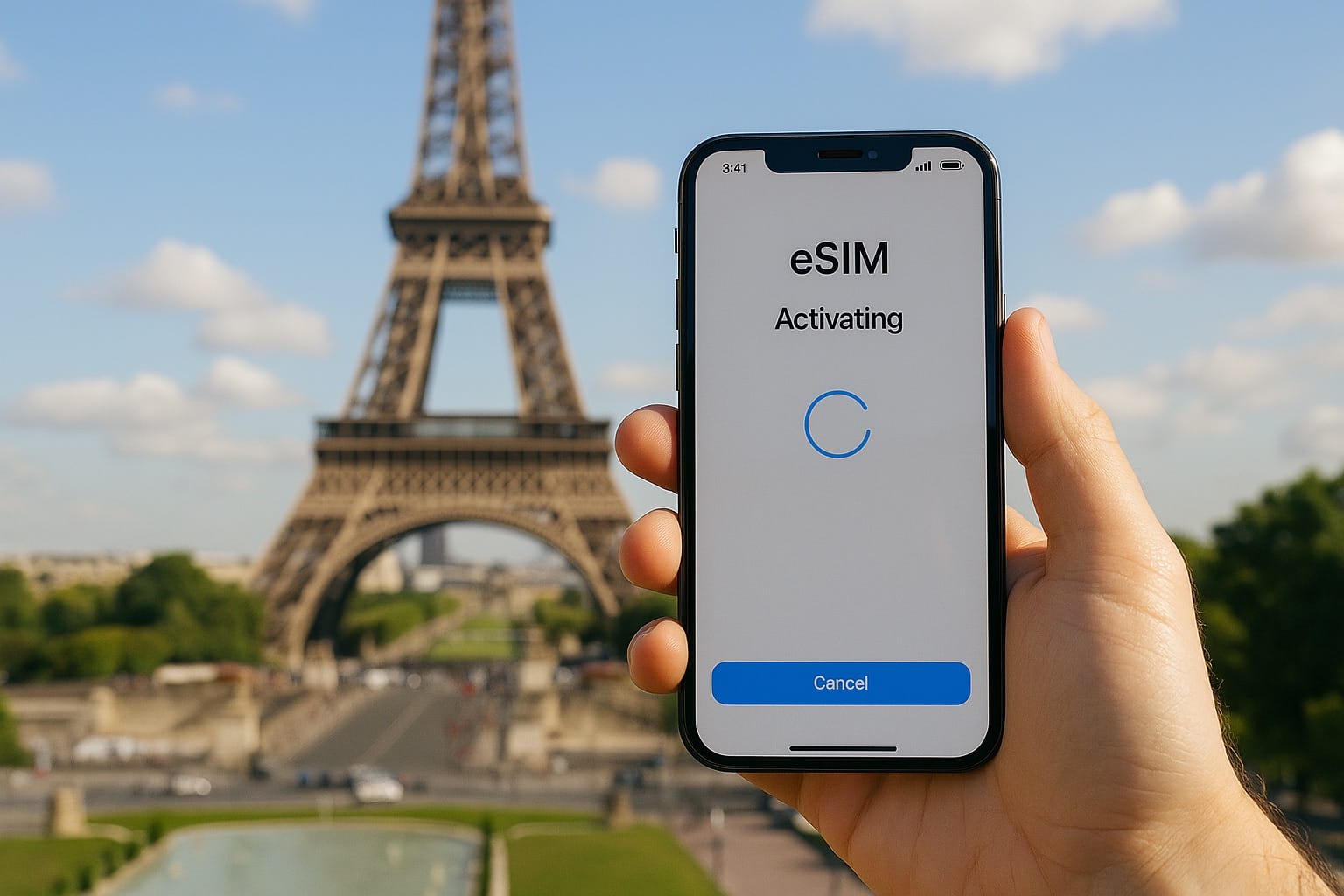
Buy your plan in the provider's app, then scan the QR code to install the profile while on stable WiFi. Most eSIMs activate within minutes. Do the install before you fly.
This post contains affiliate links to Holafly, Airalo, Airhub, Nomad, and SimLocal. If you purchase through our links we may earn a small commission at no extra cost to you. We only recommend eSIMs we have used ourselves as a family. All opinions are our own.